
 Analysis of Patent is carried on the basis of following:
- Novelty
- Inventive Step – Patent / Utility Model Patent
- Jurisdictional Patentability (Based on the country’s patent law)
Novelty means that the invention (product or process) should be new; inventive step means that the invention should not be obvious to a skilled person and should involve or include a technical advancement and patentability means any invention that does not fall within the scope of sections 3 and 4 of the Indian Patents Act, 1970. The Indian Patent Office (almost all global patent offices) mandates an invention to be new, non-obvious and industrially applicable to be granted as a patent.
 While novelty, inventive step and industrial applicability are common and basic requisites to get a patent granted in almost all countries of the world; it is also not worth the expense of patenting an invention when 1. the invention doesn’t suit the users of all countries; 2. the cost of patenting does not justify the possible ROI from a country; 3. the level of inventiveness of the invention does not meet the regular patent requirements of all countries and many other factors. Well before proceeding ahead with the patent process for your invention, we create the right patenting strategy for your invention, your budget, your market focus and other niches.
 A prior art search in simple words is a gross or detailed search on the closeness or identicality or similarity of inventions or research articles or publications or products or any information that currently exists in any public domains that my hinder the novelty or inventiveness of your invention to be granted the ownership of a patent. Although not a mandatory process, it will ensure that you save a huge money before initiating the actual patent process. Reach out to us to assist you in making informed decisions with either a gross or detailed searches before investing money on filing your patent.
 In cases where the company is aware of the existing knowledge regarding the invention but yet wants to pursue to manufacture or sell the invention, a freedom to operate search is performed. A freedom to operate search aids a company to understand the patents that are already acquired and how not to infringe/obstruct the same by his product or process. In simple words, freedom to operate enables a company to freely operate in the market where the patent is already obtained for the same or similar thing just by minor changes in his invention without it being novel or involving any inventive step
 After obtaining a patent, it is required to maintain the validity of the same. A validity search makes sure that the company or a person who has the rights to his invention does not get infringed by any third party. A validity search will help the company or inventor to claim damages against the infringement caused by the third party for its invention.
 In case an inventor or a company comes across any new research, there is a high possibility that other people in similar field might be carrying out similar research work. Thus, a patent landscape analysis is carried out to analyze the patents obtained in similar field or research work by the competitor companies and accordingly strategize the development of the invention.
 Patent drafting is the art of presenting a technical document in a manner to clearly and sufficiently express an invention in a technically detailed and legally strong manner. It is one of the most crucial aspects for a patent to get granted proving its quality. To file a patent application, it is mandatory to disclose the invention in detail so as a skilled person would understand the invention. A patent application disclosing all the details regarding the invention is known as a specification. The specification can either be a provisional specification or a complete specification.
Drafting of a patent application (specification) requires not only good technical knowledge but legal knowledge as well. Technical knowledge will enable a skilled person to portray its invention in most efficient way and legal knowledge would enable him to obtain a patent certificate by meeting all the requirements as per the Indian Patent Office. Patent drafting, therefore, requires a skilled person to understand the invention through the details as given by the inventor and at the same time abide by the law.Although it is expensive and essential to professionally draft a good patent specification before filing the application in a patent office, it does not make sense to pay a same fee irrespective of an invention being simple or complex; irrespective of holding an invention’s defensive IP strategy etc. Thus Allinnov provides you an opportunity to choose between our different patent packages thereby enabling you defining the cost of drafting a patent specification that rightly suits your budget, strategy and invention. See Patent Drafting packages.
After all the research and development of the invention, analysis and drafting of an application, filing of the application is a crucial skill as it needs to be as per the law. Filing of provisional or complete specification requires good understanding of the law and an experienced person to guide the company or inventor as to how the law works in order to meet the requirements of the respective governments as per their jurisdictions.
Even though the governments are different in different jurisdictions, understanding the law requires a skilled person. It is necessary to abide by the law as it makes it easier for the company and the government to complete the procedural requirements and obtain a patent.
Filing of the provisional or complete specification in different jurisdiction are different but requires few essential details to be disclosed. For example, name and address of the company, name, address and nationality of the inventors, declaration by the inventors of assigning their patent rights to the company, details of their patent attorney, etc.
On filing of the application, the company or the inventor on who’s name the application is filed will become ‘Applicant’ for the said patent application. While India and some other countries have a provisional patenting system, this option is not available in all countries and also if you have filed a provisional patent application it just means you have reserved the date and unless the complete patent specification is filed within the timeline (usually 12 months from the date of filing the provisional application) your provisional patent application your date reservation will be considered void.

Publication of a patent application is the first public disclosure of your invention by the patent office as an act of notifying the global patent watchers or inventors that an invention holding a corresponding title and description has been introduced to the public that reserves the date of filing and all other related information to the patent application so that anyone planning to or working on the same or similar invention can consider this as a prior art and anyone else planning to establish a commercial interest with or without knowing the existence of a patent application for the same or similar invention will be aware that the invention’s right is reserved by the applicants of the published patent application and the infringing upon it may raise legal consequences on the go. Infringing a published patent application may be considered as infringing a granted patent itself in certain situations and hence in some aspects a published patent application will be considered equivalent to a granted patent .
Many patent offices (not all) publish a patent application before the grant and the standard timeline for the same is usually 18 months from the date of filing or date of priority and however in India, a patent application can be requested to be published earlier at anytime before the 18 months timeline upon paying an additional fee to the IPO towards expediting the public disclosure of your invention much more earlier.
 It is mandatory to file a request for examination of the application by the Applicant in order to obtain a patent. A request for examination can be filed at the time of filing of the application itself or within thirty-one months from the date of filing of the application.
The Indian Patent Office encourages filing of patent applications and grant of the same, and has therefore, introduce expedite examination as well, provided if the Applicant meets some specific requirements.
For example, if one of the Applicant is a female, or if the Applicant is financially or substantially supported by the government of India, or is a department of government of India, then a request for expedite examination can be filed.
A request for expedited examination of the application means to fast track the application and enables the Applicant to obtain a patent certificate at the earliest.
 As the Examination Report is prepared by the Patent Office for the Applicant which consists of objections raised by the Patent Office with respect to invention as well as the procedural shortcomings of the law, it must be appreciated that to address the said objections in the Examination Report requires a skilled person that understands the law and the technical aspect of the invention.
Thus, analyzing the Examination Report requires a qualified Patent Attorney who is thoroughly aware of how to address the objections raised in the Examination Report within a time period as given by the Patent Office. Thus, analyzing the Examination Report requires a qualified Patent Attorney an experienced professional / patent agent / attorney who is thoroughly aware of how to address the objections raised in the Examination Report within a time period as given by the Patent Office.
 Upon receiving the Examination Report and analyzing the objections raised in it, the next step is to draft a response for the same. Drafting of the response to the objections raised in the Examination Report is a skill. Addressing the objections raised in the Examination Report is similar to preparing written arguments for a case.Responding to an office action issued by a patent office requires the right strategy that will ensure best suited long term protection of the patent both during prosecution as well as post grant.
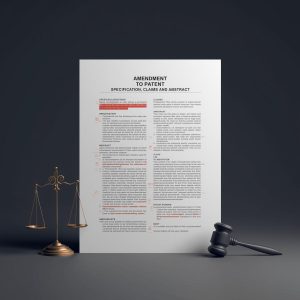 In the Examination Report, there are prior arts (previously published/granted documents) which are cited by the Controller to the Applicant. Thus, in view of the prior arts, there is a possibility that amendment of specification, claims and abstract might be required.
Based on how close the prior arts to the invention and if there are any specific objections with respect to drafting of the specification (including claims, abstract and drawings), the Applicant can amend the same in order to overcome the objections and distinguish the invention with the prior arts clearly.
Thus, in order to distinguish the invention from the prior arts through claim amendments so as to overcome the objections raised in the Examination Report, required a highly qualified Patent Attorney,to ensure the objections are appropriately addressed as they are supposed to be.
 On filing the response to the Examination Report, the Patent Office (The Controller) shall review the same and if there are still further objections, the Patent Office shall be providing another chance through hearing.
As mentioned above, A hearing can be attended by the Patent Agent / attorney or the Applicants themselves, hpwever it is highly advisable to have this handled by a professional.
A hearing is a presentation of response to the objections raised in the hearing notice orally. It is a way of orally presenting arguments/explanations to the Controller with respect to the objections raised in the hearing notice.
 After attending the hearing, the arguments/explanations provided during the hearing, needs to be submitted at the Patent Office in the writing as well and therefore, it is termed as ‘written submissions’.
While an applicant can attend the hearing and prepare the written submissions, if efficiency and output matters, it is better that a Patent Agent / Attorney to attend the hearings, prepare an file the hearing written submissions in appropriate manner to the patent office on behalf of the applicants based on the directions/suggestions given by the Controller during the hearing.
This statement “Thus, maintaining the deadlines and meeting the same is one of the most important managing skills required for a Patent Agent / Attorney .”
Non-filing of the written submissions within a timeline, will result in abandonment of the application which cannot be revived.
Thus, maintaining the deadlines and meeting the same is one of the most important managing skills required for a Patent Attorney.
After filing of the written submissions, if the Controller/Patent Office is convinced, a patent certificate shall be granted in the name of the Applicant. However, if the Patent Office is not convinced, a further opportunity of hearing may be provided by the Patent Office or the application may be rejected/refused.
 The term ‘opposition’ means to oppose or to be against and the term ‘pre-grant’ means before the grant of the patent certificate. Thus, pre-grant opposition means opposing grant of a patent certificate for an application/invention.
A pre-grant opposition can be filed by any interested person which has been defined in the Section 25(1) of the Patents Act, 1970, and Rule 55.
A pre-grant opposition requires drafting and filing of an application opposing as to why a patent certificate should not be given to the Applicant. Thus, a pre-grant opposition can be filed by any interested person, at any time, before the grant of the patent certificate. Patent Agents / Attorneys at Allinnov are experienced professionals in handling such oppositions against your patent applications.
If the Controller/Patent Office is convinced with the said application, the Controller shall ask the Applicant to reply to the same and would further provide an opportunity of hearing both the parties.
 After grant of a patent certificate, maintaining the same requires to meet few formal procedures such as filing a statement regarding the working of the invention every year along with a specific fees.
The fees of maintaining a patent is provided in schedule I of the Patents Act, 1970.
 If the maintenance / renewal fee of a granted patent was not paid by the deadline or within the extended date of deadline, your granted patent will be lapsed or abandoned by the Patent Office; in such most countries allow a patent to be requested for restoration to regain its rights under certain circumstances if an application for the same is filed within a defined timeline. Our team of attorney / agents are experts in handling your patent restoration applications with the Patent Office and in case your patent is within the restoration timeline from the date of expiry our team will assist you in all aspects.
 Licensing and Assignment of a patent are processes through which the right to commercially use a patent shall be partially or completely transferred to another party/parties through custom legal arrangements.
If you wish to let anyone (exclusive licensing) or different parties simultaneously (non-exclusive licensing) to use your patented invention for a defined period of time, you can rent or lease your patent on the basis to pay an upfront fee or as royalties in installments while retaining the right of ownership to yourself so that the patent’s right to use may or may not be issued to the same parties again after the said period is over; such a transfer of right is known as licensing.
Further if the very ownership of one or more or all applicants of a patent is completely transferred to another person or company permanently thereby completely transferring the right of use such a transfer of right is knows as assignment.
In both scenarios, the right can be transferred at any stage of the patent application after filing irrespective of whether the patent is granted. At Allinnov, we are experts in handling the complete procedures of all your licensing and assignment requirements.

India and certain other countries in the world provide an opportunity for a granted patent to be opposed on legal / formal grounds within a defined period of time. Such oppositions are to be handled with due care in all aspects towards responding back such opposition notices or attending to hearings, at Allinnov our team of experts shall assist you in all aspects of such opposition proceedings